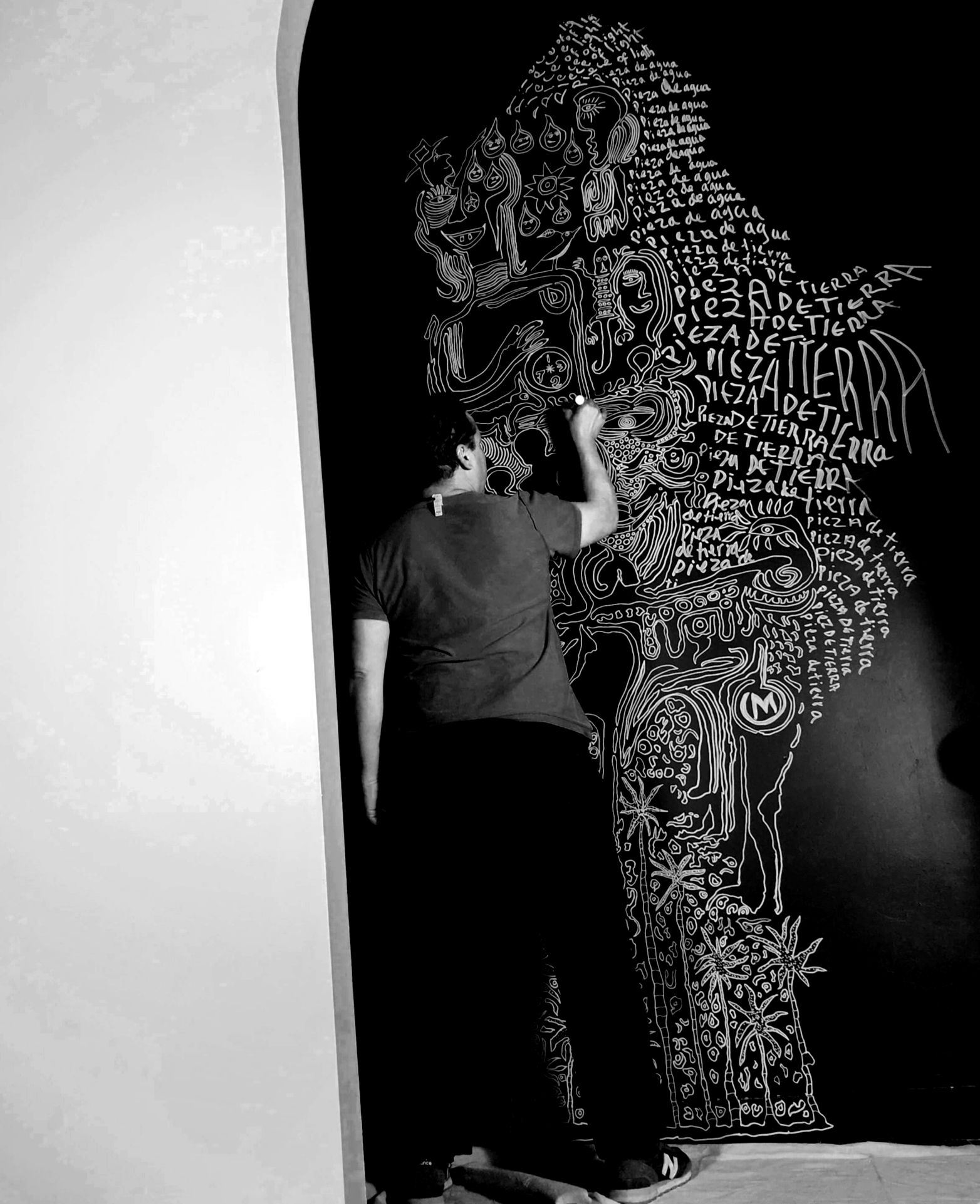
Portrait of a Practice
On Moving Meaning
Every life eventually discovers its own recurring question.
Mine has never been confined to a profession.
It has appeared under different names, in different countries, through different media, and in different communities. I first encountered it while studying philosophy in Colombia. Later I recognized it again in classrooms in Texas and Puerto Rico, in editorial meetings in New York, in bilingual literacy programs, in literary journals, behind a camera, on the roof where I paint every spring, and in conversations with students, readers, artists, and strangers.
The question has always remained the same.
How does meaning move from one consciousness to another?
Everything I have done has been an attempt to answer that question.
Teaching became one method.
Translation another.
Editing another.
Research another.
Painting another.
Rather than separate professions, they became different instruments within the same investigation.
For this reason I have never understood my career as a sequence of occupations. I understand it as a continuous practice whose medium changes according to the nature of the problem before it.
I
The Formation of Attention
I was born in Manzanares, a small town in the Colombian Andes where language, memory, landscape, and oral tradition still shaped everyday experience. My earliest education did not begin in institutions but in observation: mountains, rivers, birds, gardens, religious imagery, conversations, and silence.
When I later entered the study of philosophy and literature, I discovered that thinking itself could become a craft. Philosophy trained me to ask better questions. Literature taught me that ideas possess rhythm as well as structure. Together they established the habits that continue to guide every project I undertake.
Long before I considered becoming an artist, I had already begun drawing relationships between disciplines rather than treating them as independent territories.
This tendency has remained constant throughout my professional life.
II
Language as Architecture
Most people understand language as communication.
I understand it as construction.
Every sentence organizes reality.
Every translation reconstructs a world.
Every lesson arranges relationships between ideas.
Every editorial decision reshapes the experience of another reader.
Because of this, my work as an editor, translator, teacher, and curriculum developer has never been primarily linguistic. It has been architectural.
The task is not to simplify complexity but to organize it so another person may enter it.
Educational publishing, literary editing, university teaching, and bilingual curriculum development became laboratories in which this architecture could be tested daily.
III
Teaching as Conversation
Teaching has occupied more than two decades of my life.
Yet I have never believed that education consists in transmitting information.
Knowledge cannot simply be transferred.
It must be reconstructed.
The classroom therefore becomes less a place of instruction than a place where thought becomes visible.
Whether discussing philosophy, literature, Spanish language, ethics, medical terminology, or bilingual literacy, my objective has always been identical: create the conditions under which understanding becomes possible.
Students do not remember explanations.
They remember discoveries.
This conviction continues to influence every editorial decision, every public lecture, and every painting.
IV
Editing as an Ethics of Attention
Editing is among the least visible of professions.
When successful, it disappears.
Its presence survives only in the clarity experienced by another person.
For more than a decade my editorial work has involved educational publishing, literary journals, bilingual curriculum, translation, localization, manuscript development, and interdisciplinary collaboration. Yet the essential activity has remained remarkably simple.
To pay attention.
Attention reveals unnecessary complexity.
Attention reveals ambiguity.
Attention reveals possibilities hidden inside language.
Editing therefore became less a technical profession than an ethical discipline: the practice of helping another person's ideas become fully themselves.
V
Painting as Thinking
Painting arrived relatively late.
Not as an escape from language.
As its continuation.
The paintings do not illustrate philosophical ideas.
They investigate them.
Questions previously explored through essays or classrooms began to demand another material vocabulary: pigment, cloth, gesture, rhythm, emergence, biological growth, memory, transformation.
What appears in the studio today carries within it the accumulated experience of classrooms, editorial offices, translations, philosophical texts, gardens, films, conversations, and years spent observing how people understand one another.
Painting has gradually become the place where all previous disciplines meet.
VI
Public Practice
Knowledge reaches its fullest meaning only when shared.
Throughout my career I have participated in conferences, artist talks, editorial collaborations, classrooms, workshops, public lectures, literary publishing, filmmaking, and community projects.
These are not secondary activities.
They complete the work.
Ideas do not exist in isolation.
They exist in dialogue.
For this reason I continue to seek collaborations that bring together education, publishing, museums, visual art, literature, and public conversation.
Epilogue
One Practice
If there is coherence in my career, it is not because I have pursued a single profession.
It is because every profession I have practiced has asked the same thing of me.
To observe carefully.
To think critically.
To communicate honestly.
To make difficult ideas inhabitable.
The media have changed.
The investigation has not.
My work continues wherever ideas require another form.
Whether that form becomes a lesson, a translation, a curriculum, a lecture, an exhibition, a film, or a painting is determined not by identity but by necessity.
The practice remains one.